
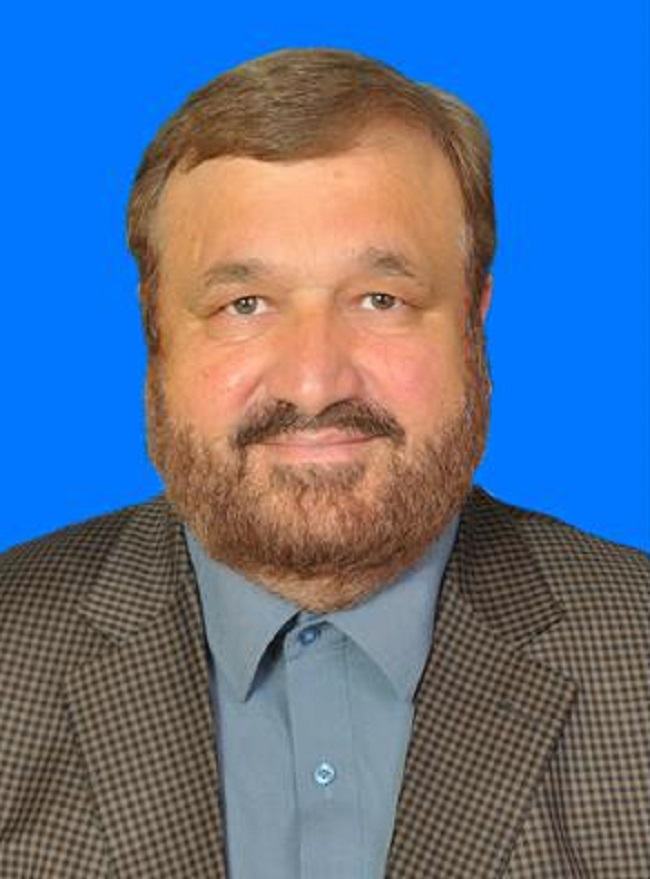
Senator Syed Muhammad Pir Sabir Shah, widely and respectfully known as Pir Sabir Shah, is among the most senior and experienced political figures from Khyber Pakhtunkhwa, Pakistan. His career reflects decades of service across provincial, federal, and legislative roles.
As an Advisory Board Member of GRAO, he now channels that experience toward strengthening governance, access to justice, and community resilience. His role is to provide strategic insight, credibility, and guidance that helps GRAO remain effective, principled, and deeply connected to the realities of Khyber Pakhtunkhwa.
The honorific “Pir” reflects a long-standing tradition of social guidance and community trust in the region. Growing up in that environment, Senator Pir Sabir Shah developed an early understanding of leadership as responsibility, not privilege.
He entered public life during a period of significant political and administrative change in Khyber Pakhtunkhwa. From the beginning, he was recognized for his measured temperament, ability to listen across divides, and focus on keeping institutions stable and responsive. These qualities became the hallmark of his service at every level of government.
Senator Pir Sabir Shah served as the 18th Chief Minister of Khyber Pakhtunkhwa from 20 October 1993 to 25 February 1994. While the tenure lasted four months, its significance lay in the political context.
During his tenure, he focused on three key priorities:
He left office with his credibility intact, strengthening public trust in democratic processes during a politically sensitive period.
From 1997 to 1999, Senator Pir Sabir Shah served as Advisor to the Prime Minister of Pakistan, Mr. Nawaz Sharif. This federal assignment broadened his perspective from provincial administration to national policymaking.
His responsibilities included:
This experience strengthened his understanding of intergovernmental relations, fiscal federalism, and the practical challenges of implementing policy across Pakistan.
Currently, Senator Pir Sabir Shah represents Khyber Pakhtunkhwa in the Senate of Pakistan. His work focuses on:
His position in the Senate provides GRAO with valuable insight into Pakistan’s legislative environment and evolving policy landscape.
GRAO is dedicated to strengthening governance, improving access to justice, and building community resilience through field-based programmes. As an Advisory Board Member, Senator Pir Sabir Shah’s role is strategic rather than operational.
He supports GRAO’s leadership by encouraging long-term thinking, sustainability, local capacity building, and alignment with provincial development priorities.
His reputation and decades of public service strengthen GRAO’s credibility among communities, local leaders, government institutions, and development partners throughout Khyber Pakhtunkhwa.
Drawing on his experience as Chief Minister, Advisor to the Prime Minister, and Senator, he advises GRAO on effective engagement with provincial departments, district administrations, federal ministries, and other stakeholders.
His presence on GRAO’s Advisory Board demonstrates strong governance, integrity, political neutrality in programming, and a commitment to accountability, strengthening confidence among donors and development partners.
His understanding of Pakistan’s legal, political, and social systems helps ensure GRAO’s governance, mediation, and justice programmes remain locally relevant while aligning with national policies.
Having served in executive, advisory, and legislative roles, he possesses a practical understanding of how government decisions are developed and implemented.
He values listening over speaking and substance over rhetoric. His practical approach helps keep discussions focused on meaningful outcomes.
His longstanding reputation for integrity enables him to bring together diverse stakeholders and build trust across communities and institutions.
His extensive public service experience strengthens GRAO in several important ways:
Senator Pir Sabir Shah possesses a deep understanding of Khyber Pakhtunkhwa’s geography, governance systems, social dynamics, and traditional institutions. He encourages GRAO to design programmes that respect local culture, comply with national laws, and remain practical for implementation in diverse field environments.
Rather than stepping away after holding high public office, Senator Pir Sabir Shah has continued serving Pakistan through governance, legislation, and civil society. His journey—from Chief Minister, to Advisor to the Prime Minister, to Senator, and now Advisory Board Member at GRAO—demonstrates a lifelong commitment to strengthening institutions, justice, and community development.
His vision for GRAO emphasizes three key priorities:
He consistently reminds GRAO’s leadership that civil society should complement government by piloting innovative solutions, generating evidence, and supporting sustainable institutional development.