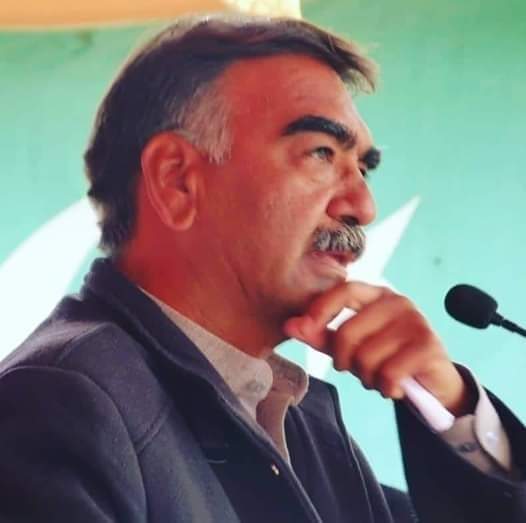
Barrister Said Hassan Khan
Board Member-GRAO
A Legacy of Justice, Mediation, & Public Service
Barrister Said Hassan Khan stands as one of Khyber Pakhtunkhwa’s most respected voices
for peace, rule of law,& community-led justice. A retired Division Officer from the historic
district of Lower Dir, Barrister Khan has devoted his career to bridging the gap between
formal legal institutions , & the lived realities of local communities.
Early Life & Legal Foundation
Rooted in the culturally rich ,& mountainous region of Lower Dir, Barrister Khan developed
an early understanding of how disputes, when left unresolved, can fracture entire
communities. After completing his legal education & qualifying as a Barrister, he chose a
path that combined statutory knowledge with traditional wisdom. This dual foundation would
later define his most impactful work.
15
16
His background as a Division Officer gave him administrative experience, insight into
governance, , & a practical understanding of how policy translates on the ground. That
experience, paired with his legal training, positioned him uniquely to address conflict not just
through law books, but through dialogue.
Chairman, Dispute Resolution Council [DRC], Timergara: 7 Years of Transformative Service
For the past seven years, Barrister Khan served as Chairman of the Dispute Resolution
Council, Timergara. The DRC model in Khyber Pakhtunkhwa was created to provide
accessible, non-adversarial forums for resolving disputes before they escalate to prolonged
court litigation.
Under Barrister Khan’s leadership, the Timergara DRC became a benchmark for
effectiveness across the province. His approach was never one-size-fits-all. He listened first,
mediated second,& applied the law with empathy always.
The Scale of Impact:
During his tenure, Barrister Khan personally mediated ,& successfully resolved over 5,000
complex cases. The caseload reflects both volume and gravity:
Murder and Qisas/Diyat Matters: Cases involving loss of life are among the most sensitive.
Barrister Khan facilitated reconciliations that balanced legal requirements, Islamic principles
of restorative justice, , & the need to prevent inter-family feuds from spanning generations.
Land & Property Disputes: In a region where land is both heritage , & livelihood, disputes
can become intractable. His council demarcated, documented, and reconciled claims that
had stalled for decades.
Family, Inheritance, & Community Conflicts: From marital disputes to water rights, he
helped families , & neighbors find durable solutions outside the pressure of formal
courtrooms.
By resolving these matters through mediation, Barrister Khan saved thousands of families
from years of litigation, financial strain, , & social division. The DRC under his chairmanship
became a trusted space where adversaries could become neighbors again.
Recognition by the Government of Khyber Pakhtunkhwa
Exceptional public service attracts attention. In recognition of his outstanding performance,
integrity, , & contribution to access to justice, the Government of Khyber Pakhtunkhwa
honored Barrister Khan with an official award.
The award acknowledged three things that defined his work:
Speed without sacrificing fairness – Cases moved quickly, but every party felt heard.
Consistency with the rule of law – Mediation was never a substitute for justice, but a pathway
to it.
16
17
Community trust – People traveled from remote valleys of Dir to bring their disputes to
Timergara because they believed in the process.
That recognition cemented his reputation not only as a skilled Barrister, but as a public
servant committed to peace.
Philosophy: Justice Beyond the Courtroom
Barrister Khan often notes that “not every wrong needs a judge, but every wrong needs a
resolution.” His philosophy rests on three pillars:
Preventive Justice: Resolve conflict early so it does not become criminal or generational.
Culturally Informed Mediation: Respect local customs & Jirga traditions while ensuring
outcomes align with Pakistan’s legal framework & constitutional rights.
Restoration Over Retribution: Where possible, rebuild relationships instead of deepening
wounds.
This philosophy explains why over 5,000 families left his council with agreements they were
willing to uphold long after they walked out the door.
Role as Board Member, GRAO
Today, Barrister Said Hassan Khan serves as a Board Member of GRAO. GRAO is an
organization focused on strengthening governance, access to justice, & community
resilience through field programs. In this capacity, Barrister Khan brings three critical assets
to the Board:
Expertise in Conflict Resolution: His proven mediation model informs GRAO’s program
design in post-conflict & high-tension districts.
Community Mediation Capacity Building: He advises on training paralegals, local
mediators, & DRC members to replicate effective practices across KP & beyond.
Rule of Law Integration: He ensures that community mechanisms remain aligned with
statutory law, human rights standards, & the needs of vulnerable groups, including women &
minorities.
Board colleagues describe him as “practical, principled, & people-centered.” He reviews field
data, listens to implementers, & translates complex legal concepts into actionable guidance
for teams on the ground.
Impact on Rule of Law in Lower Dir & Beyond
The rule of law is not only about courts and statutes. It is about whether ordinary citizens
believe disputes can be resolved fairly, affordably, & quickly. Barrister Khan’s work directly
strengthened that belief in Lower Dir.
Reduced Court Burden: By diverting thousands of cases to mediation, he eased pressure
on an already overburdened judiciary.
17
18
Increased Legal Awareness: Parties who come to DRC leave understanding their rights &
obligations more clearly.
Social Cohesion: Reconciled families are less likely to engage in retaliatory violence,
creating safer neighborhoods.
A Model for the Future:
Pakistan’s justice sector faces challenges of backlog, cost, & access. Barrister Khan’s model
shows what is possible when legal expertise meets community trust. He demonstrates that:
Mediation can handle serious cases when conducted by trained, ethical leaders.
Government & civil society can partner effectively through structures like DRCs.
Local leaders can scale impact by documenting results & mentoring others.
As GRAO expands its programs, Barrister Khan’s experience offers a roadmap for
replication in other districts of Khyber Pakhtunkhwa & across Pakistan.
Personal Reputation & Leadership Style
Beyond titles & numbers, Barrister Khan is known for his humility, patience, & clarity.
Litigants recall that he never rushed a hearing. Colleagues note that he credits his team for
successes & takes responsibility for shortcomings.
He speaks plainly,avoids legal jargon when unnecessary, & treats every person who enters
the mediation room with dignity. That demeanor is why adversaries trust him & why
agreements hold.